


LET’S STUDY POSOLOGY THROUGH CLINICAL ERRORS: A CASE-SERIES ANALYSIS ON POTENCY, DOSE, AND REPETITION.
Authors
DOI:
https://doi.org/10.59939/3048-6270.2025.v3.i4.13Keywords:
Posology, LM potency, susceptibility, minimum dose, repetition, potency selection, homoeopathy, case seriesAbstract
Background: Posology—comprising potency, dose, and repetition—is a decisive factor in homoeopathic prescribing. While remedy selection is widely discussed in literature and seminars, inappropriate posology continues to cause failures and aggravations.
Aim: To analyse three clinical cases in which prescribing errors related to potency, repetition, or dose highlighted fundamental principles of posology.
Method: A retrospective case-series analysis of three patients who experienced disturbance in progress due to a posological error. Each case was evaluated for clinical presentation, remedy selection, potency choice, follow-up outcomes, and the theoretical framework guiding interpretation.
Results:
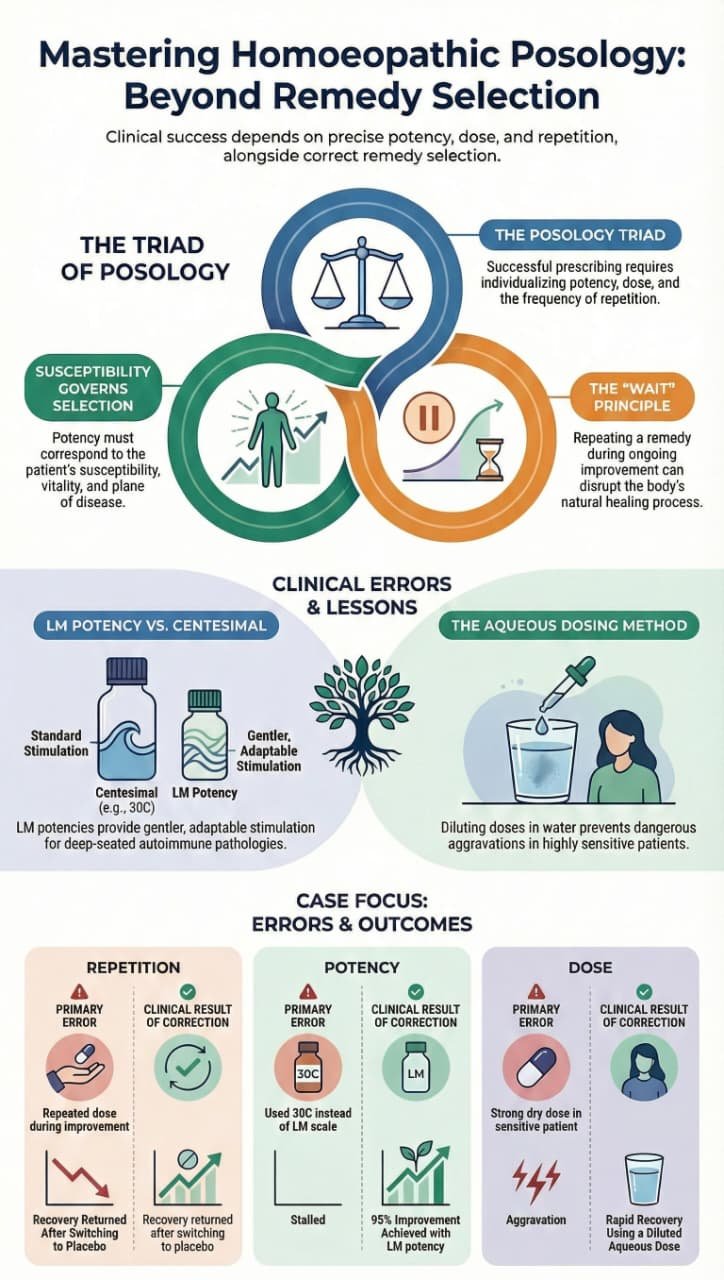
Case 1: Unnecessary repetition of a well-selected remedy (Staphysagria 1M) disturbed a favourable reaction.
Case 2: A correct remedy (Pulsatilla) failed in 30C potency but acted curatively in LM potency when susceptibility was reassessed.
Case 3: A strong dry dose (Stramonium 1M) caused aggravation in a sensitive patient; diluted aqueous dosing produced rapid recovery.
Conclusion: Remedy selection alone is insufficient without precise attention to potency, dose, and repetition. These cases affirm classical principles of susceptibility, minimum dose, and judicious repetition, highlighting the need for stronger academic emphasis on posology.
Author Biography
Downloads
Published
Issue
Section
License

This work is licensed under a Creative Commons Attribution-NonCommercial 4.0 International License.
This article is Open Accessible and licensed under a Creative Commons Attribution NonCommercial 4.0 International License. You are welcome to use this work non-commercially as long as author is credited by citing the work.